
Read This Odu in Other Languages
 Yoruba
Yorùbá
Yoruba
Yorùbá
 English
English
English
 Spanish
Español
Spanish
Español
 Portuguese
Português
Portuguese
Português
 French
Français
French
Français
 Swahili
Kiswahili
Hausa
Hausa
Igbo
Igbo
Swahili
Kiswahili
Hausa
Hausa
Igbo
Igbo
 Arabic
العربية
Arabic
العربية
 Chinese
中文
Chinese
中文
 Hindi
हिन्दी
Hindi
हिन्दी
 Russian
Русский
Russian
Русский
 German
Deutsch
German
Deutsch
 Italian
o
Italian
Italiano
 Turkish
Türkçe
Turkish
Türkçe
 Polish
Polski
Polish
Polski
 Dutch
Nederlands
Dutch
Nederlands
 Japanese
日本語
Japanese
日本語
 Korean
한국어
Korean
한국어
 Vietnamese
Tiếng Việt
Vietnamese
Tiếng Việt
 English
  Português
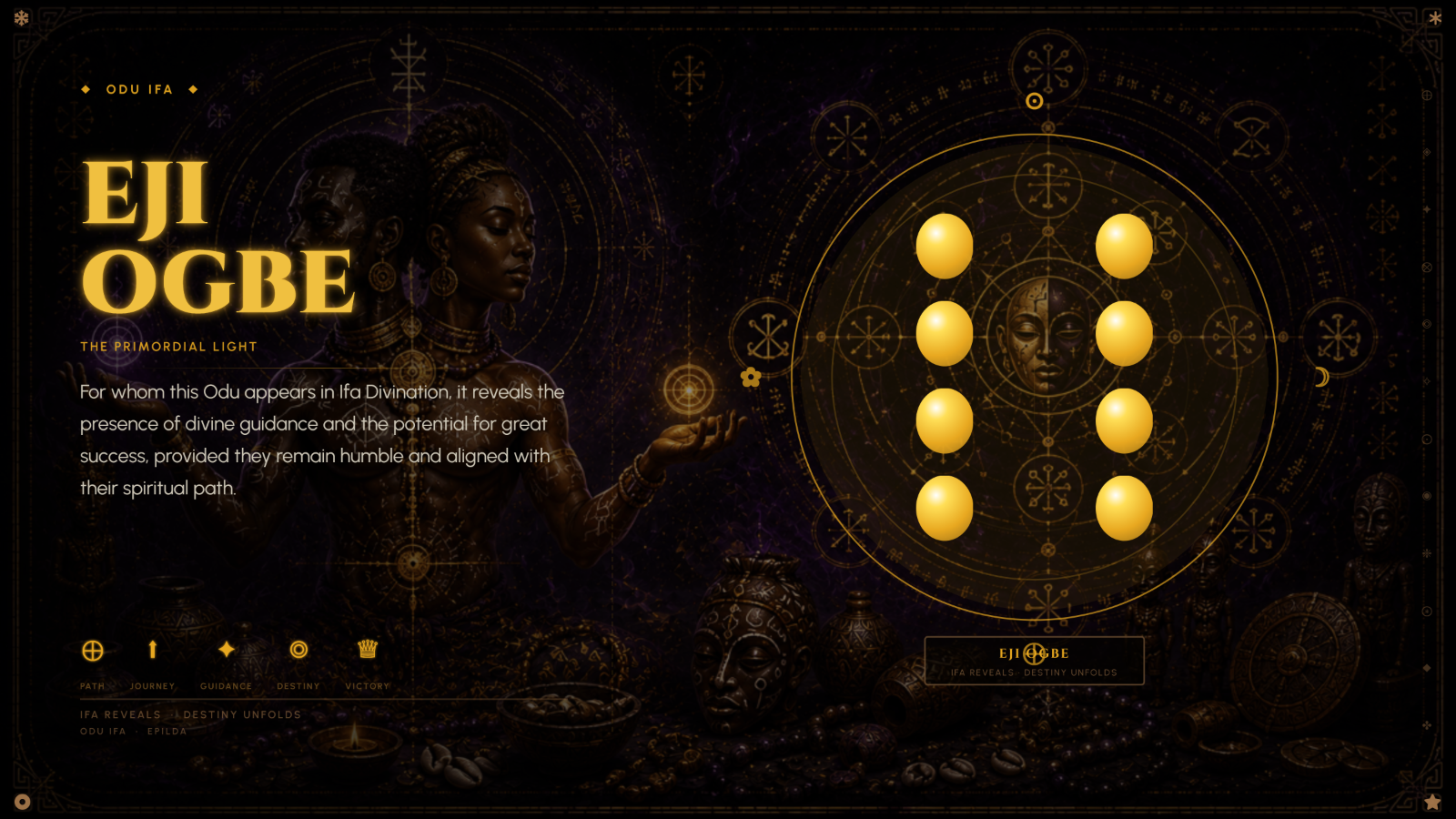
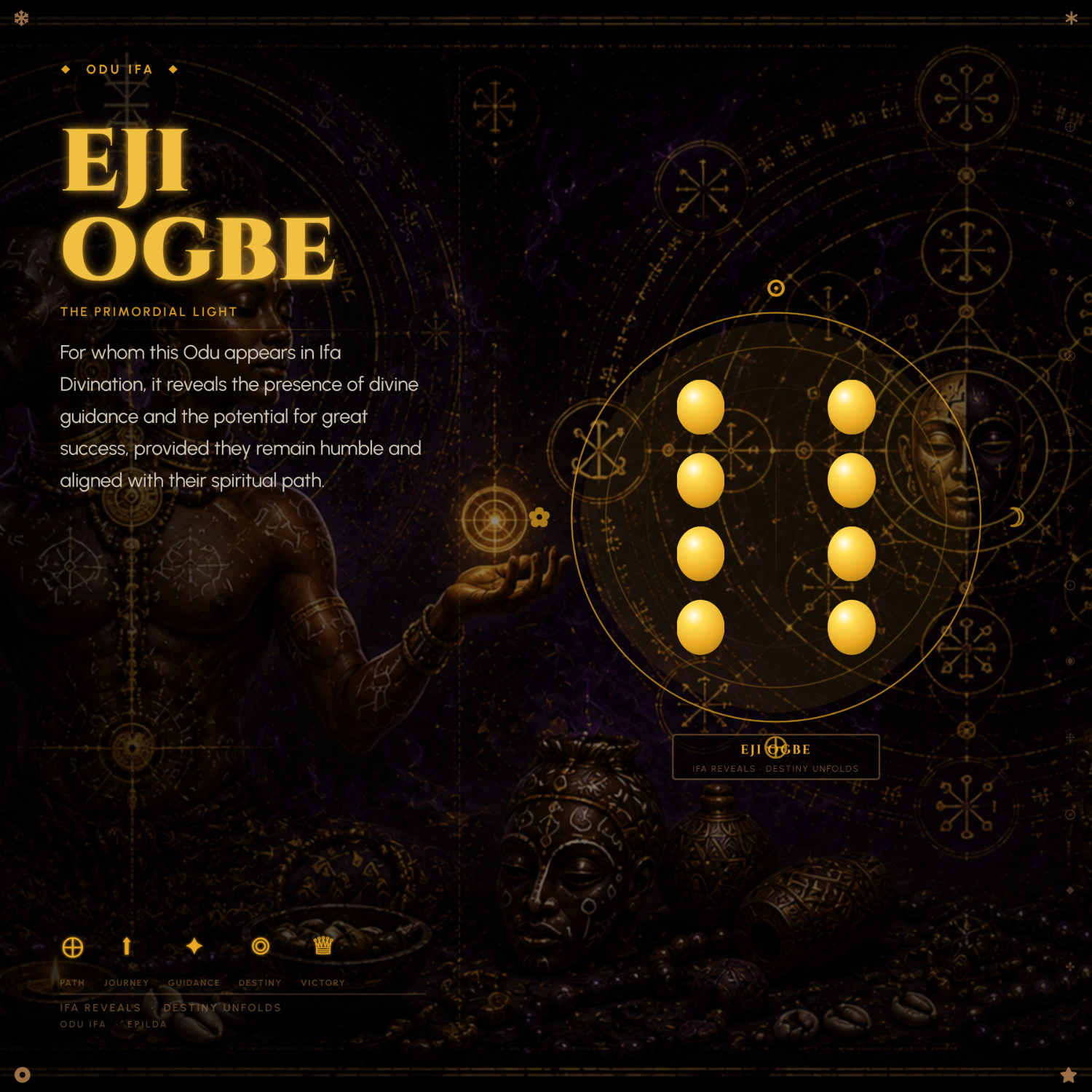
 The sacred Odu marks as cast on the Opele or Ikin divination tray
Overview
Odu Ifa Eji Ogbe, also known as Ejinimogbe or Ogbe Meji, holds the most exalted position among the 256 sacred Odu in the Ifa divination system. As the first and supreme Odu, Eji Ogbe represents light, clarity, divine blessings, and the pure manifestation of spiritual power. This Odu embodies completeness, success, victory, and the highest form of spiritual elevation achievable through proper conduct and sacrifice.
The divinations within Eji Ogbe address fundamental human aspirations: the desire for ease and prosperity, the completion of important endeavors, victory over obstacles, and the attainment of leadership positions. Each verse within this Odu serves as both spiritual instruction and practical guidance, teaching us how divine intervention transforms ordinary circumstances into extraordinary blessings when we align ourselves with the cosmic order through proper sacrifice and righteous behavior.
Eji Ogbe's appearance in divination is considered highly auspicious, signaling that all forms of blessings are being called forth for the individual. However, these blessings require activation through prescribed rituals and offerings. The teachings emphasize that success is not merely a matter of luck but the result of spiritual alignment, proper conduct, and faithful adherence to divine guidance. To understand how Eji Ogbe relates to other Odu, explore the comprehensive guide on the 16 Odu Ifa and their meanings.
Ifa Divination for the Father of Ajero Manje Le: The Path to Effortless Prosperity
Understanding the Divine Promise
This divination from Eji Ogbe reveals one of the most powerful promises in the entire Ifa corpus: the calling forth of all blessings for the person who receives this Odu. The verse speaks to those who have been struggling, those whose tears have flowed in abundance while waiting for their blessings to manifest. Ifa declares that through proper sacrifice, life can transform from one of struggle to one of effortless ease, symbolized by the life of the snail.
The reference to the father of Ajero Manje Le represents anyone who has been crying for their blessings to come. The wisdom here is profound: blessings are available, but they require activation through sacrifice. The emphasis on offering many snails to Ifa is particularly significant, as the snail represents a life of peace, slow but steady progress, and the ability to carry one's home (success and protection) wherever one goes.
The Symbolism of the Snail
The snail holds deep spiritual significance in this divination. Unlike creatures that must struggle and fight for survival, the snail moves through life with ease, carrying everything it needs upon its back. It leaves behind a trail that smooths its path, representing how proper spiritual preparation makes life's journey easier. The snail's shell provides constant protection, symbolizing the divine covering that comes from faithful adherence to Ifa's guidance.
When Ifa prescribes eight snails as part of the offering, this number is not arbitrary. Eight represents abundance and completeness in Yoruba numerology. The snails, combined with a rooster, palm oil, cornmeal, and kola nuts, create a powerful spiritual formula that attracts prosperity while ensuring that success comes with ease rather than through endless struggle.
The Sacred Verse
Bi ojo bakanrin
Orun a ro woo
Adifa fun baba ajero manje le
Igba ti momi oju sogbere ire gbogbo
Ebo won ni o se
O gbebo nibe orubo
Nje, kini aye igbin se
Ero woo salaye igbin
Igbin ase erowo
English Translation
As the day passes gently
The sun shines brilliantly
This was the Ifa declaration for the father of Ajero Manje Le
At the time when tears flowed in abundance for all blessings
He was advised to offer a sacrifice
He complied and offered the sacrifice
Now, what defines the life of a snail?
The life of a snail is one of effortless ease
The snail exemplifies a life of tranquility and prosperity
Practical Application for Modern Times
For individuals facing this divination today, the message is clear: your period of struggle is coming to an end, but you must participate in your own deliverance through sacrifice. The offering of eight snails, one rooster, palm oil, cornmeal (eko), and kola nuts represents a commitment to spiritual transformation. Each element serves a specific purpose in realigning your spiritual energies with the forces of prosperity and ease.
This divination particularly speaks to those who have been working hard but seeing little result, those whose efforts seem to evaporate like water poured on hot sand. Eji Ogbe promises that through proper sacrifice, the universe will begin to support your efforts, making success flow naturally rather than requiring constant struggle. The transformation is from swimming against the current to floating effortlessly with the tide of divine favor.
Learn more about the foundational principles of Eji Ogbe at the dedicated Eji Ogbe page, and explore the differences between Eji Ogbe and other Ogbe variations.
Eji Ogbe, Ejinimogbe: Ifa Divination for Olokira - Breaking the Cycle of Incomplete Tasks
The Challenge of Uncompleted Work
This divination from Eji Ogbe addresses a frustrating and debilitating pattern that affects many people: the habit of starting projects with enthusiasm but never bringing them to completion. This pattern, known as "aseti" in Yoruba, represents more than simple procrastination—it indicates a spiritual blockage that prevents the manifestation of one's efforts into tangible results.
Olokira's story speaks to anyone who has experienced the disappointment of beginning ventures that never reach fruition, of making plans that never materialize, of investing time and energy into endeavors that somehow evaporate before completion. This is not merely a matter of willpower or discipline; it is a spiritual condition that requires spiritual intervention.
The Role of Abede, the Priest
The divination specifically mentions Abede, described as "the priest of Olokira." This detail is significant because it emphasizes that breaking this cycle requires spiritual expertise. Just as we consult medical doctors for physical ailments, persistent patterns of incomplete work require consultation with those who understand the spiritual dimensions of success and completion.
Abede's prescription for Olokira was specific: two roosters, one hen, a rat, fish, and one goat. Each animal in this offering carries symbolic significance. The roosters represent vigilance and the ability to mark time (to know when to begin and when to finish). The hen symbolizes nurturing energy that sees projects through to maturity. The rat and fish represent sustenance and the resources needed to maintain effort, while the goat represents the stubbornness and determination required to push through to completion.
The Sacred Verse
Abede awo olokira
Adifafun olokira
Ti n fi ojojumo sowo aseti
Won ni korubo
Ko mon ba maa sowo ase ti
O osi gbebo nibe orubo
Nje abede ode
Awo olokira
Orunmila mon je ki olokira o se aseti
English Translation
Abede, the priest of Olokira
Divined for Olokira
Who had been doing things without success
He was instructed to offer a sacrifice
So that he would not face the habit of leaving tasks uncompleted
And he complied
Thus, Abede has arrived
The priest of Olokira
Orunmila, do not let Olokira face the habit of leaving tasks uncompleted
Breaking Free from the Pattern
The power of this divination lies in Orunmila's declaration: "Do not let Olokira face the habit of leaving tasks uncompleted." This is not merely a wish or a hope; it is a divine pronouncement that, when combined with the proper sacrifice, restructures reality itself to support completion rather than abandonment.
For modern practitioners facing this challenge, the lesson is clear: examine your life for patterns of incomplete work. Are there businesses you started but never finished? Relationships you began but never developed? Skills you started learning but never mastered? Educational pursuits you initiated but never completed? These patterns indicate a need for the spiritual intervention prescribed in this verse.
The offering must be made with sincere intention and understanding of what each element represents. As you present each animal, you are essentially asking that the qualities it represents be activated in your life. The two roosters mean you will become vigilant about time and completion. The hen means you will develop the nurturing persistence needed to bring projects to full maturity. The rat and fish ensure you will have the sustenance and resources to maintain your efforts, and the goat grants you the stubborn determination to see things through regardless of obstacles.
For deeper understanding of Ifa divination practices, consult the comprehensive resource on African Traditional Religions: Ifa Divination.
Ifa Divination for Orunmila: Marrying Peace and Prosperity
The Divine Marriage
This divination reveals one of the most beautiful metaphors in the Ifa corpus: Orunmila's marriage to a "peaceful world." This is not merely poetic language but a profound teaching about the relationship between spiritual practice and the quality of life one experiences. Just as a person chooses a spouse with care and intention, so too must we deliberately "marry" the kind of life we wish to live through proper spiritual preparation.
The verse tells us that Orunmila was about to marry "Aye Tutu" (a peaceful world) as his wife. This metaphor teaches that peace and prosperity are not things that happen to us randomly; they are conditions we must consciously choose and commit to through spiritual practice. The marriage ceremony itself represents the ritual sacrifice that binds us to the blessings we seek.
The Meaning of Ope Asinla
The divination states that "It was with Ope Asinla that he married a peaceful world." Ope Asinla refers to a sacred palm tree with spreading branches, symbolizing expansion, growth, and the ability to provide shelter and sustenance. This teaches that victory and peace come through establishing strong spiritual foundations that grow and expand naturally, providing protection and prosperity not just for oneself but for all who come under one's influence.
The palm tree is central to Yoruba spirituality—it provides oil for lamps (illumination), wine for libations (spiritual connection), fronds for shelter (protection), and its very presence indicates life-giving water below the ground. To marry a peaceful world "with Ope Asinla" means to establish peace through deep-rooted spiritual practice that nourishes all aspects of life.
The Sacred Verse
Sigindin lepo
Sigindin niyo
Singindin ni kolo kolo adi
Adifa fun orunmila
Baba lole gbe aye tuntun niyawo
Ebo ni won ni kose
O gbebo ni be o rubo
Ope asinla lo gbaye tutu niyawo
Aye ifa tutu o joyin lo
E wa bani ni jebutu aya
English Translation
Singindin is palm oil
Singindin is salt
Singindin is the kolo kolo adi
This was the divination for Orunmila
Who was about to marry a peaceful world as his wife
He was instructed to offer a sacrifice
And he complied
It was with Ope Asinla that he married a peaceful world
The life of Ifa was peaceful, sweeter than honey
Come and join me in the sweetness of marriage
The Promise of Victory
Eji Ogbe declares that this divination brings "ire isegun" (blessings of victory) for the person who receives it. But what kind of victory? Not the victory of warfare or competition, but the victory of living in harmony with divine will, where life becomes "sweeter than honey." This is victory over struggle, victory over chaos, victory over the turbulence that characterizes ordinary existence.
The prescription is simple but powerful: one he-goat, palm oil, cornmeal (eko), and kola nuts. The he-goat represents masculine energy, determination, and the ability to overcome obstacles. Palm oil symbolizes smoothness and ease in all endeavors. Cornmeal represents sustenance and the basic provision needed for peace of mind. Kola nuts signify consciousness, clarity, and the ability to maintain awareness of one's spiritual path.
For those facing obstacles and seeking victory today, this divination teaches that true triumph comes not from fighting harder but from marrying oneself to peace through proper spiritual preparation. The invitation at the end—"Come and join me in the sweetness of marriage"—is extended to all who are willing to make the necessary sacrifice to transform their lives from bitter to sweet, from chaotic to peaceful, from struggle to ease.
Explore more about Ifa's philosophical foundations through the UNESCO documentation on Ifa divination system.
Ifa Divination for Kukunduku: The Path to Leadership and Honor
The Desire for Recognition
This divination from Eji Ogbe addresses the profound human need for recognition, honor, and leadership position. Through the story of Kukunduku (the Yam), Ifa reveals how one rises from being merely one among many to becoming the leader that all others acknowledge and follow. This is not about ego or vanity; it is about fulfilling one's destiny to lead and inspire others.
The yam holds special significance in Yoruba culture as the king of crops. Among all the tubers and vegetables, the yam is accorded the highest respect. It is the first crop celebrated during harvest festivals, and it represents prosperity, sustenance, and stability. When Kukunduku sought to become the leader among all yams, it was essentially asking to fulfill its inherent destiny—to be recognized for what it truly was.
The Formula for Leadership
The verse contains a powerful declaration: "If you carry me with you, or place me on your neck, I will never stop being blessed, I will never stop being successful." This teaches that leadership and honor come from being useful, from being the one others want to carry with them, from being valuable enough that people wish to keep you close.
True leadership, according to this Odu, is not about forcing oneself upon others or demanding recognition. Rather, it is about developing such intrinsic value that recognition comes naturally. When the divination promises "ire aseyori" (blessings of success), "isegun" (victory), and "oye" (honor/title), it is describing the natural result of becoming genuinely valuable to one's community.
The Sacred Verse
Bi e gbemi n gbegbe
Bi e ru mi ru ru
Emi ko sai deni
Emi ko sai deniyan
Adifafun kukunduku
Ti o jola lawujo isu oko
Ebo ni won ni ko se
O si gbebo nibe o rubo
A mu kukunduku joloja
Gbogbo isu oko
E posese wa
e wa sin
Gbogbo isu oko
English Translation
If you carry me with you
Or place me on your neck
I will never stop being blessed
I will never stop being successful
This was the Ifa divination for Kukunduku, Yam
Which has the intention to become a leader among the yams
It was advised to offer a sacrifice
And It complied
Therefore, we have chosen Kukunduku as the leader of the yams
All the yams come
To worship the great yam
The Path to Genuine Authority
The outcome of Kukunduku's sacrifice is telling: "We have chosen Kukunduku as the leader of the yams. All the yams come to worship the great yam." This was not imposed leadership but voluntary recognition. The other yams came willingly to honor and worship Kukunduku because its value became undeniable through the spiritual transformation that followed the sacrifice.
The prescribed offering consists of one he-goat, palm oil, cornmeal (eko), and kola nuts. The he-goat represents strength, determination, and the ability to stand firm in one's position. Palm oil symbolizes the smoothness with which true leaders operate—not through force but through natural authority. Cornmeal represents the ability to provide sustenance and support to those under your leadership. Kola nuts signify the clarity of vision and consciousness required for wise leadership.
For those seeking positions of authority, honor, or recognition today, this Odu teaches that the path forward is not through self-promotion or manipulation but through genuine self-development combined with proper spiritual preparation. The sacrifice activates the transformation, but the transformation itself must be real—you must become truly worthy of the honor you seek.
Learn more about the cultural context of Ifa from UNESCO's archives on Ifa of the Yoruba People.
Verse — Translation
As the day passes gently
The sun shines brilliantly
This was the Ifa declaration for the father of Ajero Manje Le
At the time when tears flowed in abundance for all blessings
He was advised to offer a sacrifice
He complied and offered the sacrifice
Now, what defines the life of a snail?
The life of a snail is one of effortless ease
The snail exemplifies a life of tranquility and prosperity
English — Ifa Message
Ifa says it is calling forth all blessings for the person for whom this Odu has appeared. Ifa says this individual should offer a sacrifice so that life can become easier for them, and they should offer many snails to appease Ifa.
Sacrificial Items
- 8 Snails
- 1 Rooster
- Palm oil
- Cornmeal (eko)
- Kola Nuts
Interpretation
While these traditional preparations may seem unusual to modern practitioners, they represent a sophisticated understanding of how physical substances can be imbued with spiritual intention and used to affect consciousness and fortune. Those wishing to use these formulas today should seek guidance from qualified traditional practitioners who can properly identify the herbs and perform the necessary prayers and invocations that activate the spiritual properties of the preparation.
Verse — Translation
Abede, the priest of Olokira
Divined for Olokira
Who had been doing things without success
He was instructed to offer a sacrifice
So that he would not face the habit of leaving tasks uncompleted
And he complied
Thus, Abede has arrived
The priest of Olokira
Orunmila, do not let Olokira face the habit of leaving tasks uncompleted
English — Ifa Message
Ifa says this person must offer a sacrifice so they do not face the habit of leaving tasks uncompleted, and instead be able to complete their work successfully. They must offer the sacrifice that will bring blessings.
Sacrificial Items
- 2 Roosters
- 1 Hen
- Rat and Fish as a sacrifice.
Interpretation
While these traditional preparations may seem unusual to modern practitioners, they represent a sophisticated understanding of how physical substances can be imbued with spiritual intention and used to affect consciousness and fortune. Those wishing to use these formulas today should seek guidance from qualified traditional practitioners who can properly identify the herbs and perform the necessary prayers and invocations that activate the spiritual properties of the preparation.
Verse — Translation
Singindin is palm oil
Singindin is salt
Singindin is the kolo kolo adi
This was the divination for Orunmila
Who was about to marry a peaceful world as his wife
He was instructed to offer a sacrifice
And he complied
It was with Ope Asinla that he married a peaceful world
The life of Ifa was peaceful, sweeter than honey
Come and join me in the sweetness of marriage
English — Ifa Message
Ifa calls forth blessings of victory for the person for whom this Odu has appeared. Ifa says they must offer a sacrifice so that they can overcome obstacles.
Sacrificial Items
- 1 He-goat
- Palm oil
- Cornmeal (eko), and kola nuts as a sacrifice.
Interpretation
While these traditional preparations may seem unusual to modern practitioners, they represent a sophisticated understanding of how physical substances can be imbued with spiritual intention and used to affect consciousness and fortune. Those wishing to use these formulas today should seek guidance from qualified traditional practitioners who can properly identify the herbs and perform the necessary prayers and invocations that activate the spiritual properties of the preparation.
Verse — Translation
If you carry me on your head
Or place me on your neck
I will never stop being blessed
I will never stop being successful
This was the Ifa divination for Kukunduku, Yam
Which has the intention to become a leader among the yams
It was advised to offer a sacrifice
And It complied
Therefore, we have chosen Kukunduku as the leader of the yams
All the yams come
To worship the great yam
English — Ifa Message
Ifa calls forth blessings of success, victory, and honor for this person. Ifa says they must offer a sacrifice, and they will achieve victory.
Sacrificial Items
- 1 He-goat
- Palm oil
- Cornmeal (eko), and
- kola nuts as a sacrifice.
Interpretation
While these traditional preparations may seem unusual to modern practitioners, they represent a sophisticated understanding of how physical substances can be imbued with spiritual intention and used to affect consciousness and fortune. Those wishing to use these formulas today should seek guidance from qualified traditional practitioners who can properly identify the herbs and perform the necessary prayers and invocations that activate the spiritual properties of the preparation.
Awure — Alchemist Formula
English
One will obtain the tiger's skin, with thunderstone (Edun Ara), Osun (white powder), and black soap. It will be ground into the black soap, and the person will bathe with it every morning.
Isegun / Akose — Victory Formula
Yoruba
Ao toju ewe onire kinkin pelu iyere ao fi se igbin merin lepo ni yo ao wa se adura si ao je.
English
One will obtain Onire Kinkin herbs with Iyere and use them to cook four snails with palm oil and salt. They should say their prayer before eating it all.
Related Odu — Same Family & Pairs


Explore Ifa
Eji Ogbe is one of the 256 sacred Odu Ifa — the corpus of divination verses that form the foundation of the Yoruba oracle system. Each Odu contains multiple Ese (verses) alongside their Ase (spiritual power), Ebo (sacrifice), and Akose (alchemical remedies).
Odus that share the same family or pairing include: Ogbe Oyeku, Ogbe Iwori, Ogbe Odi, Ogbe Irosun.
Reflections & Testimonies
Be the first to share a reflection on Eji Ogbe Odu.