

Of all the foreign policy positions Lindsey Graham held over his career, his stance on Russia was the most consistently hawkish and — by the end — the most personally consequential.
Russia issued a criminal arrest warrant against him in 2023. He had, by then, been calling for maximum pressure on Moscow for nearly a decade.
His Russia position cannot be separated from his Ukraine advocacy — the two developed together after 2014 and became defining features of his final years in the Senate.
Before 2014: The Starting Point
Graham was not a Russia specialist in his early Senate years. His attention was primarily on the Middle East — Iraq, Iran, Afghanistan, Israel.
Russia was on his radar as a strategic competitor but not yet a primary focus. That changed with the 2008 Russo-Georgian War, after which he began pushing for a harder American line on Russian behavior in its near abroad.
2014–2022: Sanctions and Military Aid
Russia's annexation of Crimea in 2014 sharpened Graham's focus considerably. He pushed for sanctions that went beyond what the Obama administration initially proposed and called for arming Ukraine when the official policy was non-lethal assistance only.
He was instrumental in building bipartisan Senate support for successive rounds of sanctions targeting Russian officials and business interests.
He was among the first American officials to publicly call Vladimir Putin a war criminal — a characterization he repeated regularly throughout the 2022 invasion.
2022–2026: Maximum Pressure
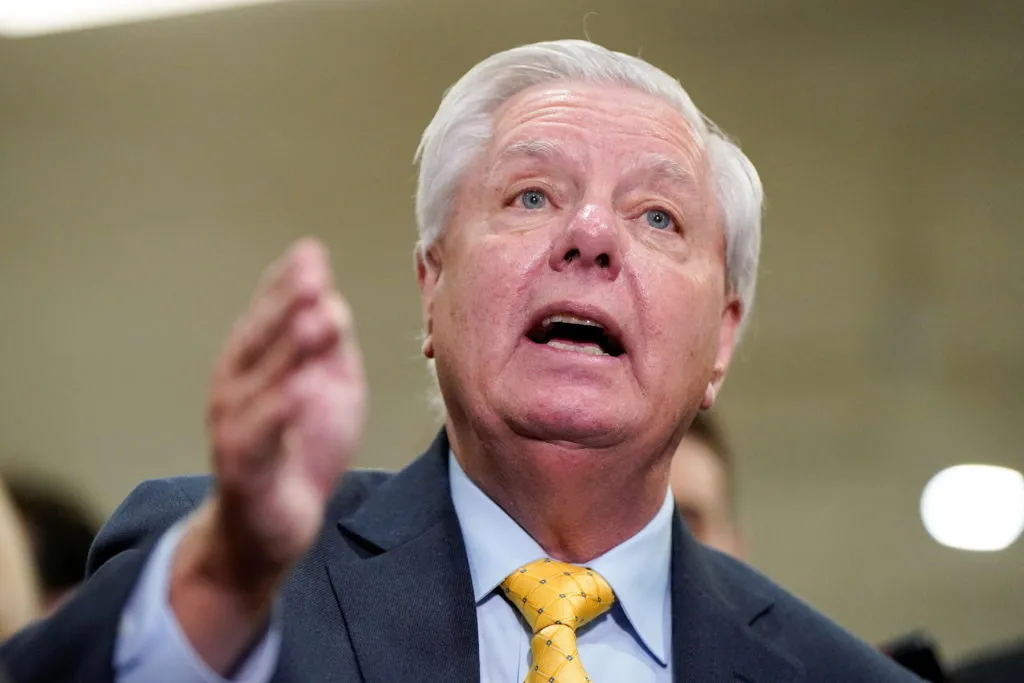
After the full-scale invasion of Ukraine, Graham became one of the most vocal proponents of maximum economic and military pressure on Russia.
He supported seizing Russian sovereign assets held in Western financial institutions and using the proceeds to fund Ukrainian reconstruction. He called for extending the most severe sanctions to Russia's energy sector.
In 2023, during a visit to Kyiv, he made remarks suggesting someone in Russia should assassinate Putin — comments he framed as rhetorical but which Russian officials cited in formal diplomatic protests. He also made the "best money we've ever spent" remarks during the same period.
The Arrest Warrant
Russia issued a criminal arrest warrant for Graham in 2023, citing the incitement remarks about Putin and the Ukraine war comments.
International legal scholars noted the warrant had no binding effect outside Russian jurisdiction — Graham could not be arrested in any country that did not extradite to Russia, which effectively meant all of NATO and most of the democratic world.
But the symbolism was significant: a sitting U.S. senator was a named criminal in Russia's legal system. The full context of the Russia arrest warrant is covered separately.
What He Believed
Graham's views on Russia were not simply anti-Russian sentiment. They were grounded in a particular theory of international relations: that authoritarian powers test and exploit weakness, that early resistance is less costly than later resistance, and that the United States has both the interest and the obligation to lead that resistance.
He applied this framework to Russia, China, Iran, and North Korea consistently, though Russia became his primary focus in his final years.
His political legacy and the broader assessment of his support for military engagement provide additional context for understanding how his Russia position fit into the totality of his career.