

Before Tomi Adeyemi wrote a single scene, she went to Salvador, Brazil.
She was there on a fellowship after graduating from Harvard, studying West African mythology and the Yoruba culture that had survived the Middle Passage to put down roots in the Americas.
What she encountered changed her. She saw Yoruba spirituality not as a relic or an academic subject but as a living system — worshipped, practised, central to community life in ways that European visitors rarely document fairly.
That experience became the foundation of Children of Blood and Bone and the world she named Orïsha.
What Are the Orishas?
In the Yoruba religion, originating among the Yoruba people of what is now southwestern Nigeria and Benin, the Orishas are divine spirits that act as intermediaries between humans and Olodumare — the supreme being, the source.
They are not gods in the European polytheist sense, though they are often described that way for accessibility. Each Orisha governs a domain: storms, rivers, iron, love, the hunt, the ocean.
The Orishas are not distant or abstract. In Yoruba practice, they can be invoked through ritual, through song, through specific offerings. They have personalities, preferences, and histories. They quarrel, reconcile, intervene.
The religion was carried to the Americas through the transatlantic slave trade, and survives today in Candomblé (Brazil), Santería (Cuba), Trinidad Orisha, and other traditions. The Yoruba diaspora is one of the most globally distributed in the world.
Visit Epilda's dedicated guide to Orisha tradition.
How Adeyemi Translated Mythology into Fantasy
Adeyemi's fictional kingdom is not simply a fantasy Africa. It is specifically Yoruba in its spiritual architecture. The name Orïsha itself signals this — the kingdom is named for the divine forces that shape it.
The maji in her trilogy are divided into clans aligned with specific Orishas. Zélie's clan draws power from Oya — the Yoruba goddess of storms, wind, and transformation, associated with the Niger River, with change, with violent weather.
/orisa/oya/
Oya is also the goddess who stands at the crossroads between life and death. For a character like Zélie, who channels grief into power and operates between survival and destruction, that alignment is precise.
/orisa/yemoja/
Yemoja, the Orisha of the ocean and rivers, the mother of many other Orishas, governs another clan. Shango, the Orisha of thunder, lightning, and justice, governs another.
/orisa/ogun/
Ogun, the Orisha of iron, war, and labour, governs another. These are not invented powers. They are real figures from a real tradition, translated into fantasy with the care of someone who spent time learning what they mean.
Yoruba Names and Language
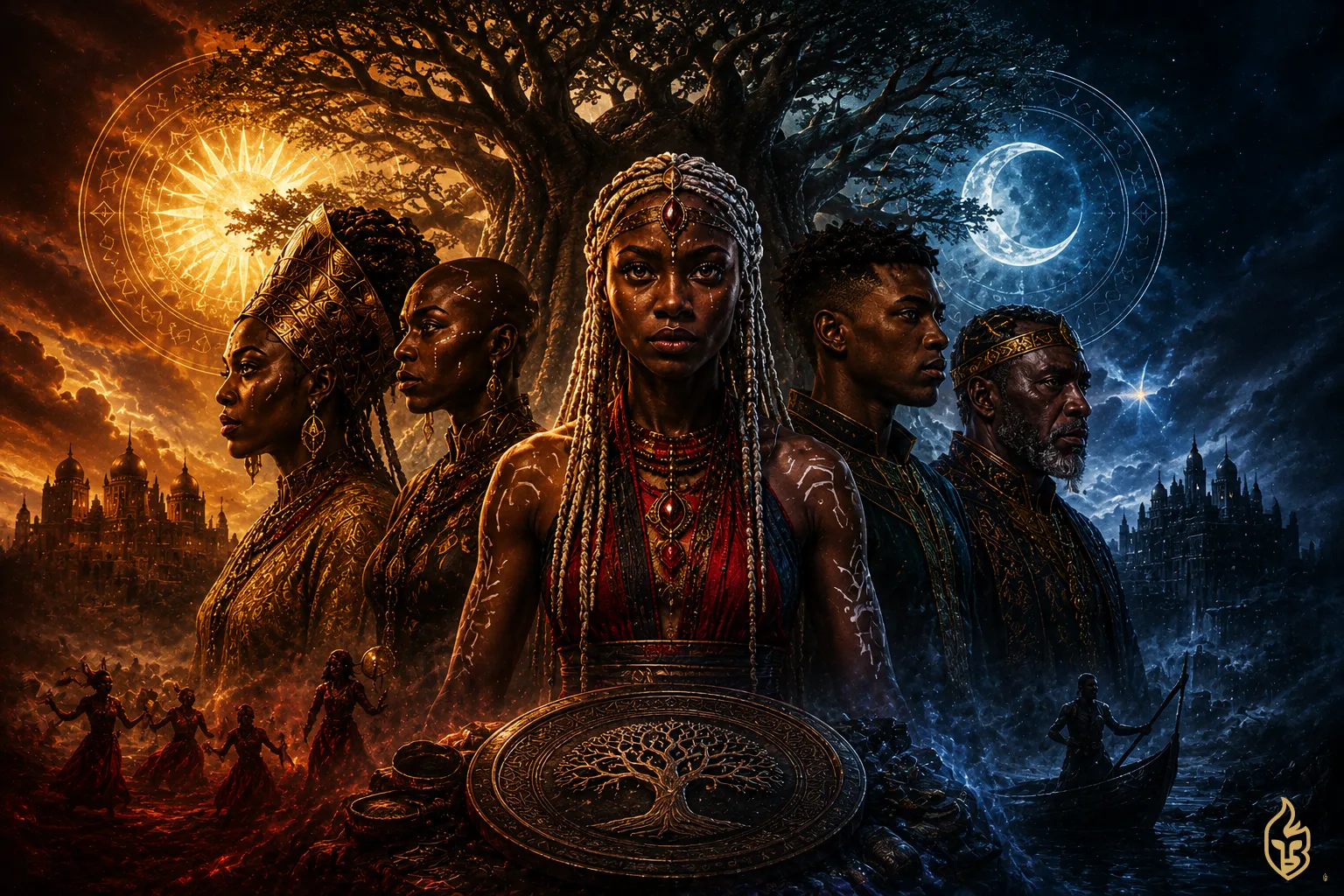
One of the small but significant choices Adeyemi made was ensuring every character has a Yoruba or African name. The novel is peppered with Yoruba words and phrases — not as flavour text but as load-bearing elements of the world.
Characters wear dashiki, iro and buba, gele. The food, the social structures, the spiritual practices all carry specific cultural referents.
This matters because it is not common. Fantasy literature has a long history of taking inspiration from non-European traditions while stripping them of their specific cultural identity — creating generic "tribes" and "shamans" and "spirits" that owe a debt to real traditions without acknowledging it.
Adeyemi names her sources. That is a form of respect and a form of authority.
Why This Matters Beyond the Books
The global success of Children of Blood and Bone introduced millions of readers outside Africa and the diaspora to Yoruba mythology for the first time.
Many readers report going from the novel to actively researching the Orishas, Yoruba history, and the spiritual traditions Adeyemi drew from. That kind of cultural gateway is rare.
It also matters within the diaspora. For readers of West African descent, particularly in the United Kingdom and United States, seeing their own spiritual traditions treated as worthy of a fantasy epic — rather than as something to explain or apologise for — carries a weight that is difficult to overstate.
The film adaptation, directed by Gina Prince-Bythewood and shot in Lagos, will bring this mythology to an even larger audience in 2027. Whether the screen translates what the page achieved is the question. The mythology, at least, is real enough to carry it.
— FAQ —
Is the Yoruba religion still practised today?
Yes. Yoruba religion is actively practised by tens of millions of people worldwide, including in Nigeria, Benin, Brazil, Cuba, Trinidad, and across the African diaspora.
Are the Orishas in Children of Blood and Bone real deities?
The Orishas mentioned in the novel — Oya, Yemoja, Shango, Ogun — are real figures from Yoruba spiritual tradition. Adeyemi's use of them in a fantasy context is rooted in genuine research, though her novel creates its own fictional interpretation of how their powers manifest.
What inspired Tomi Adeyemi to use Yoruba mythology?
A fellowship in Salvador, Brazil, after graduating from Harvard, where Adeyemi studied West African mythology and witnessed the living expression of Yoruba culture in the African diaspora.